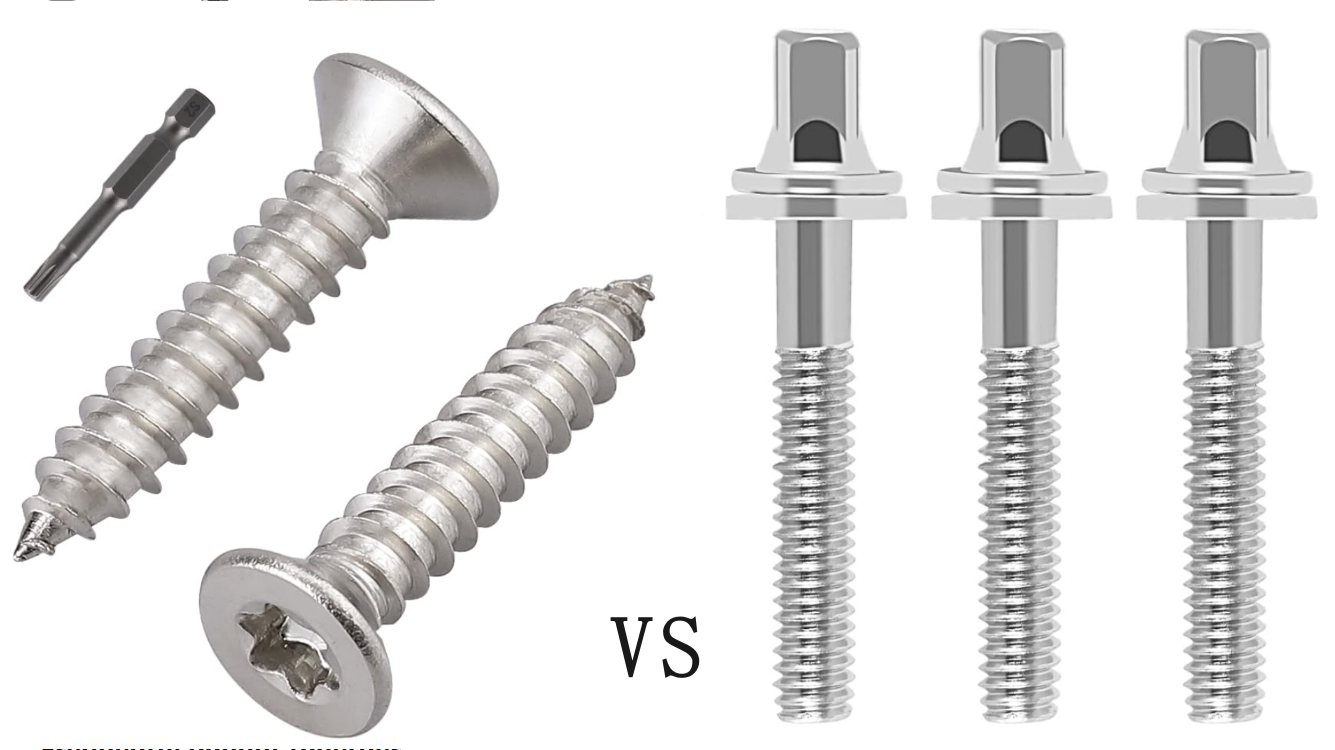
Nearly every industrial assembler or production engineer has encountered this common issue: when driving a screw into dense substrate or heavy industrial framing, the screw head snaps off mid-installation. Most often, the fastener is immediately blamed for poor quality, but in the vast majority of cases, the failure stems from a critical misunderstanding of two core fastening principles: Torque and Tension.
With decades of professional fastener manufacturing experience, tianyu has observed this issue across industrial assembly lines and construction projects throughout Europe. Many operators hold the misconception that “tighter equals stronger”, but excessive torque does not guarantee a secure joint. In fact, confusing torque and tension is the leading cause of loose fastener joints, rattling machinery, and premature assembly failure in industrial applications.
Core Definitions: Torque vs. Tension
- Torque: The rotational force applied to the screw head, the measurable input effort during installation.
- Tension (Preload): The desired output — the clamping force that pulls two materials together to form a secure, long-lasting joint.
Think of a screw as a rigid industrial spring: the slight stretch created during installation generates tension, which is what keeps the joint locked tight. Torque is merely the method used to create this critical stretch.
The Industry 90/10 Rule: Where Torque Is Lost
The widely accepted 90/10 Rule explains why torque rarely translates directly to tension: for a standard dry screw, only ~10% of applied torque converts to usable clamping tension. The remaining 90% is lost to friction — ~50% between the screw head and bearing surface, and ~40% between the mating threads.
Environmental factors like dust, moisture, and minor thread corrosion drastically increase friction, leaving as little as 5% of torque to create clamping force. The screw may feel tight to the operator, but the joint lacks sufficient preload, leading to loosening over time from vibration or thermal expansion.
Key Installation Pitfalls & Best Practices
A common industrial mistake is over-lubricating screws. While lubrication reduces friction, it also removes the natural safety buffer that prevents over-tightening. Applying the same torque to a lubricated screw as a dry one can direct nearly all input force into stretching the screw, causing permanent deformation, head snap-off, or thread stripping.
Stainless steel fasteners require extra care: softer than carbon steel, they are prone to galling (cold welding of threads from friction-generated heat). For optimal results, use slow, consistent drill speed and steady pressure to avoid thread damage.
Follow these core rules for reliable industrial fastening:
- Keep threads clean and debris-free to maintain consistent friction
- Use washers to create a smooth bearing surface and reduce head friction
- Avoid relying solely on tactile feedback; verify joint closure visually
- For critical joints, tighten until surfaces mate, then apply a single controlled final turn to set preload
FAQ
Q: Why do screw heads snap off during tightening?
A: Over-tightening is the primary cause, typically from over-lubrication removing friction buffers, or driving without a properly sized pilot hole in dense materials. This is rarely a material quality issue, but rather a torque control error.
Q: Should I lubricate screws to ease installation?
A: Lubrication reduces installation effort, but it also increases over-tightening risk by up to 40%. If lubrication is required for corrosion protection, reduce applied torque significantly and avoid over-turning.
Q: Why do stainless steel screws get stuck mid-installation?
A: This is galling (cold welding), caused by high friction and heat from high-speed installation. Use slow drill speeds and consistent pressure to prevent thread fusion.